Home / Breeds / Australian Shepherd
Australian Shepherd
Smart, driven, loyal and intense. From United States (despite the name).
Herdingmedium breedUnited States (despite the name)Standards checked
Standards checked: this profile's facts are checked against the breed standards of the AKC, The Kennel Club and the FCI, as described on our methodology page.
Gallery
Real photos from licensed sources only, each credited to its creator.


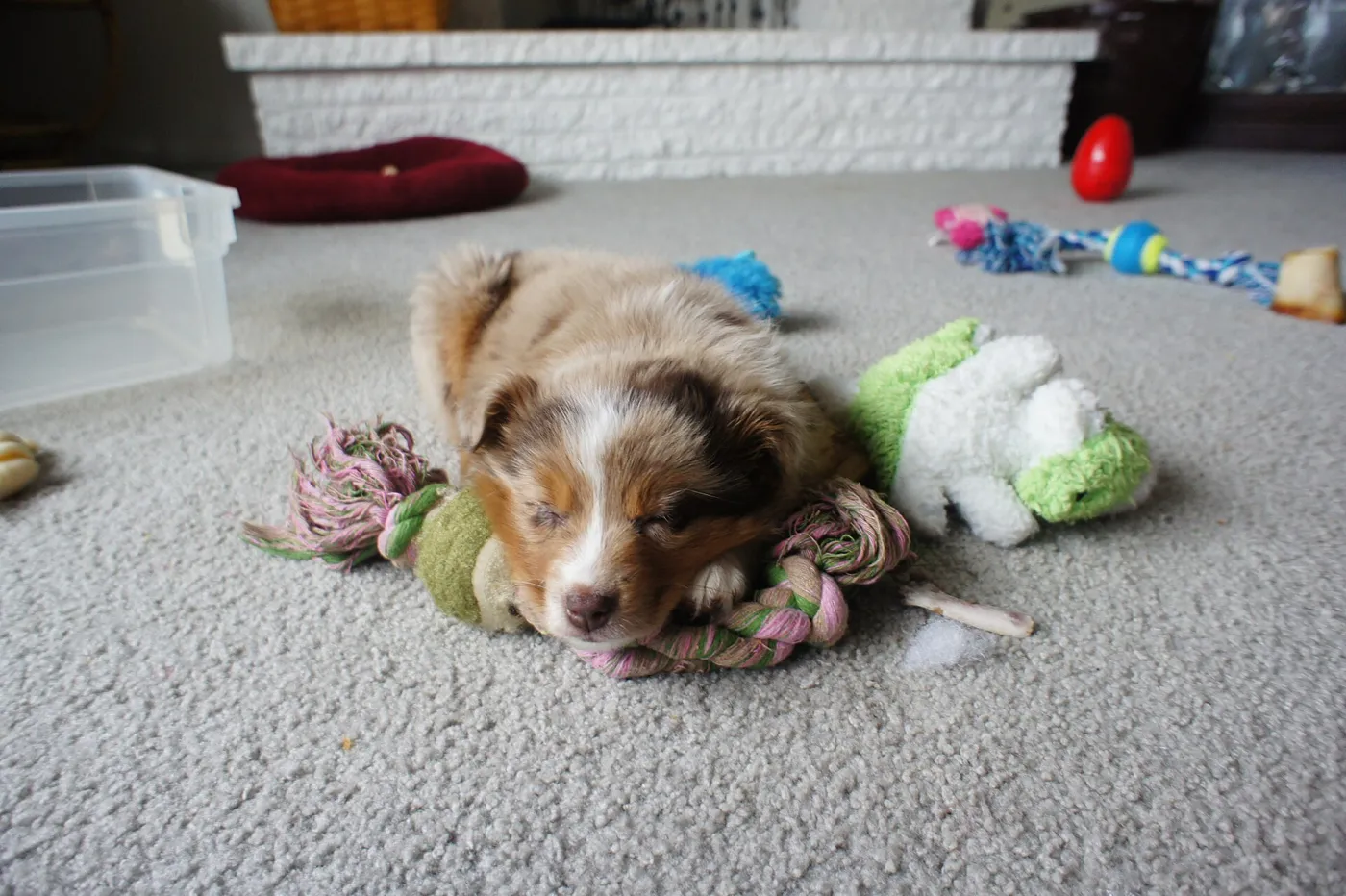


Photos show different individual dogs from licensed libraries, not one dog growing up. Stage labels are approximate, the way a careful editor would judge them.
About the Australian Shepherd
The Aussie is a tireless, whip smart herding dog that thrives on work, sport and adventure. These dogs bond hard and think fast, and they will herd children, chase bikes and reorganize your furniture if life gets boring. Best for active owners who want a training partner.
History
Despite the name, the breed was finished in the American West, where Basque shepherds who had worked in Australia brought their dogs to California ranches in the 1800s. Rodeo fame in the twentieth century spread the breed.
Personality
The Australian Shepherd runs on intensity: intense loyalty, intense energy and an intense need to understand what is happening and what happens next. Aussies are problem solvers that learn routines, open doors and anticipate commands, and they bond to their people with a following devotion that earns them the velcro label. Strangers get a reserved assessment before acceptance. The herding brain never fully switches off, so the breed watches movement constantly and wants to organise it. Sensitive to their owner's moods and quick to learn the household's rules and loopholes alike, Aussies are exhilarating company for people who enjoy training and exhausting for people who wanted a quiet dog.
Temperament and traits
Energy (5/5)
Trainability (5/5)
Grooming needs (3/5)
Shedding (4/5)
Barking (4/5)
Good with children: Good with children
With other dogs: Usually good with dogs
With strangers: Reserved with strangers
Apartment life: Not ideal
Coat and care
Coat: Medium length water resistant double coat with a thick undercoat.
Colors: Blue merle, red merle, black and red, often with white and tan markings.
Give this brain a daily workout as well as the body: training, puzzle feeders and sport all count. Brush weekly, more in shedding season, and check the merle pattern eyes regularly.
Exercise and grooming
Exercise
Ninety minutes to two hours a day, and the mix matters as much as the minutes. Aussies need running, hiking and swimming for the body and herding, agility, obedience or trick training for the brain, every single day. A jog and a game of fetch will not touch the sides of a young Aussie. Herding instinct spills into daily life as chasing bikes, joggers and children, so channel it into sport rather than fighting it. Puppies build up gradually and should not jump repetitively until grown. Owners who treat exercise as the day's main event get a spectacular dog; owners who squeeze it in get a landscape gardener with teeth.
Grooming
The medium double coat needs a weekly brush through with a slicker and undercoat rake, paying attention behind the ears, the britches and the chest where mats start. In shedding season expect daily sessions and drifts of undercoat. Never shave an Aussie: the coat insulates and protects the skin. Baths when muddy are enough, since the coat sheds dirt well once dry. Trim the hair between the toes for grip on hard floors, check ears weekly and keep nails short, as this athletic breed loads its feet hard. Merle dogs should have their eyes checked regularly, a point the breed's care guidance stresses.
Training and daily life
Training
Aussies learn at a speed that exposes sloppy training: teach a sloppy recall and you have a dog that has learned recall is optional, in one session. Sessions should be short, precise and varied, with rewards the dog values, and this breed excels at obedience, agility, herding and trick work. The challenges are intensity and control around movement: chase games must come with an off switch, and herding nips at heels need redirecting from the first day, not laughing off in a puppy and punishing in an adult. Socialise thoroughly so confidence keeps pace with intelligence. Owners who give an Aussie real work describe training as a conversation; owners who do not are trained by the dog.
Living with an Australian Shepherd
An Aussie is a full time lifestyle rather than a pet that fits around one. They are good with children but will attempt to herd them, good with dogs they know and reserved with strangers until properly introduced. Flats rarely work; the breed needs a house, a garden and an owner whose hobbies are outdoors and dog centred. They are velcro dogs that run the household diary, notice every deviation from routine and can become anxious and destructive when under worked. Noise can be an issue, as a bored Aussie comments on everything. For the right owner there is no more capable or entertaining partner in dog sports and outdoor life.
What an Australian Shepherd costs
Food cost
About $34 per month for a typical 52 lb adult eating roughly 3.2 cups a day of a standard quality food ($1.60 per lb). Full breakdown in our food expense calculator.
Activity and exercise
Plan 90 to 120 minutes a day of walks, play and training. Under exercised dogs of most breeds invent their own projects, and they rarely pick good ones.
Insurance cost
Typical US range $35 to $60 per month for accident and illness cover. Estimate only, based on market ranges for this breed's risk profile; see the insurance estimator and the insurance guide.
On the monthly figures above, a typical adult year runs to about $405 for food and $420 to $720 for insurance, before routine vet care, grooming and gear. Year one costs more: vaccinations, spay or neuter surgery, a crate, bedding and training all land at once.
Growth: puppy to senior
How weight typically builds with age for a medium breed, and when full size arrives.
| Stage | Age | Typical weight |
|---|---|---|
| Puppy | 8 weeks | about 6 to 9 lb |
| Puppy | 4 months | about 13 to 21 lb |
| Young | 6 months | about 21 to 34 lb |
| Young | 9 months | about 30 to 48 lb |
| Adult | 12 months | about 35 to 57 lb |
| Adult | 18 months | about 40 to 65 lb |
| Adult | Full grown | 40 to 65 lb (standard range) |
| Senior | From about 8 years | Healthy weight stays in the adult range; watch for slow gain or loss |
Growth pattern follows the size class growth curves published by the Waltham Petcare Science Institute, applied to the adult weight range in the breed standard. Individual puppies vary; steady growth matters more than hitting any single number, and your vet's growth checks come first.
Life stages
Puppies need early, wide socialisation to keep the reserved streak from becoming suspicion, plus bite inhibition work, because herding puppies nip heels enthusiastically. Adolescents are the breed at full volume: strength, stamina and opinions peak together, and sport or herding training gives the energy somewhere legal to go. Adults settle into tireless working partners, and the middle years are about keeping weight lean and the brain employed. From around eight the Aussie counts as senior on paper, though many stay vigorous for years: switch impact sport for steady hiking and scent work, watch eyes and joints, and keep training in the week, because an old Aussie still wants a job.
Health
Watch for the MDR1 drug sensitivity gene, hereditary cataracts, epilepsy and hip dysplasia. Merle to merle breeding can produce deaf or blind puppies, so choose breeders who never cross two merles.
Conditions to know about
- MDR1 drug sensitivity: Many Aussies carry a gene mutation that stops them clearing certain common drugs safely, including some wormers and anaesthetics. A simple DNA test reveals status, and every vet who treats the dog should know the result.
- Hereditary cataracts: Clouding of the lens that can affect vision in young to middle aged dogs. Breeding stock should have annual eye examinations, and DNA tests exist for the main form found in the breed.
- Epilepsy: Idiopathic epilepsy occurs in Aussie lines more than average. Most cases are managed on daily medication, and responsible breeders track and disclose seizures in their pedigrees.
- Hip dysplasia: The standard herding breed joint risk, managed by hip scoring breeding dogs and keeping youngsters lean and sensibly exercised while they grow.
Facts follow the Australian Shepherd breed standard (AKC, The Kennel Club and FCI standards agree on the essentials for this breed). Health notes summarize the conditions breed clubs and veterinary bodies most often flag for this breed. They are general information for choosing and caring, not a diagnosis or a substitute for your vet.
Gear for Australian Shepherd owners
Our team is hands on testing products for this guide right now. Recommendations will only appear here after real testing, and this module will always carry a plain affiliate disclosure at the top.
Australian Shepherd questions
How long do Australian Shepherds live?
A typical lifespan is 12 to 15 years. Weight control, dental care and screening for the breed's known conditions give a dog the best chance of reaching the top of that range.
How much does it cost to keep an Australian Shepherd?
Food for a typical adult runs about $34 a month at a standard quality tier, and accident and illness insurance usually falls between $35 and $60 a month in the US. Try the full cost calculator for a complete year one and yearly picture.
Are Australian Shepherds good with children?
Good with children. As with every breed, supervise dogs and children together and teach children to respect the dog's space.
How much exercise does an Australian Shepherd need?
Plan on 90 to 120 minutes a day, split between walks, play and training games. Puppies and seniors need gentler, shorter sessions.
Why does my Australian Shepherd herd my children?
Because herding is the software the breed runs on. Moving things trigger the chase and nip sequence, and children running and squealing are the most moving things in the house. Teach a strong recall and settle, give the dog herding or sport outlets and supervise until the habit is redirected.
Is an Australian Shepherd good for a first time owner?
Only an unusually committed one. The intelligence, energy and intensity are a lot for a beginner, and the breed punishes under exercise and boredom visibly. First timers who are sporty, home based and keen on training classes can succeed.
Do Australian Shepherds shed a lot?
Yes. The double coat sheds year round and blows out heavily twice a year. Weekly brushing keeps it civilised, daily brushing is needed in shedding season.